

Easy SEO guide for beginners & busy business persons
Weather you want to start your career as SEO or want to manage your own businessthis easy SEO guide for beginners & busy business persons is a powerful start-point.
Written By: Atta Ur Rehman Akbar
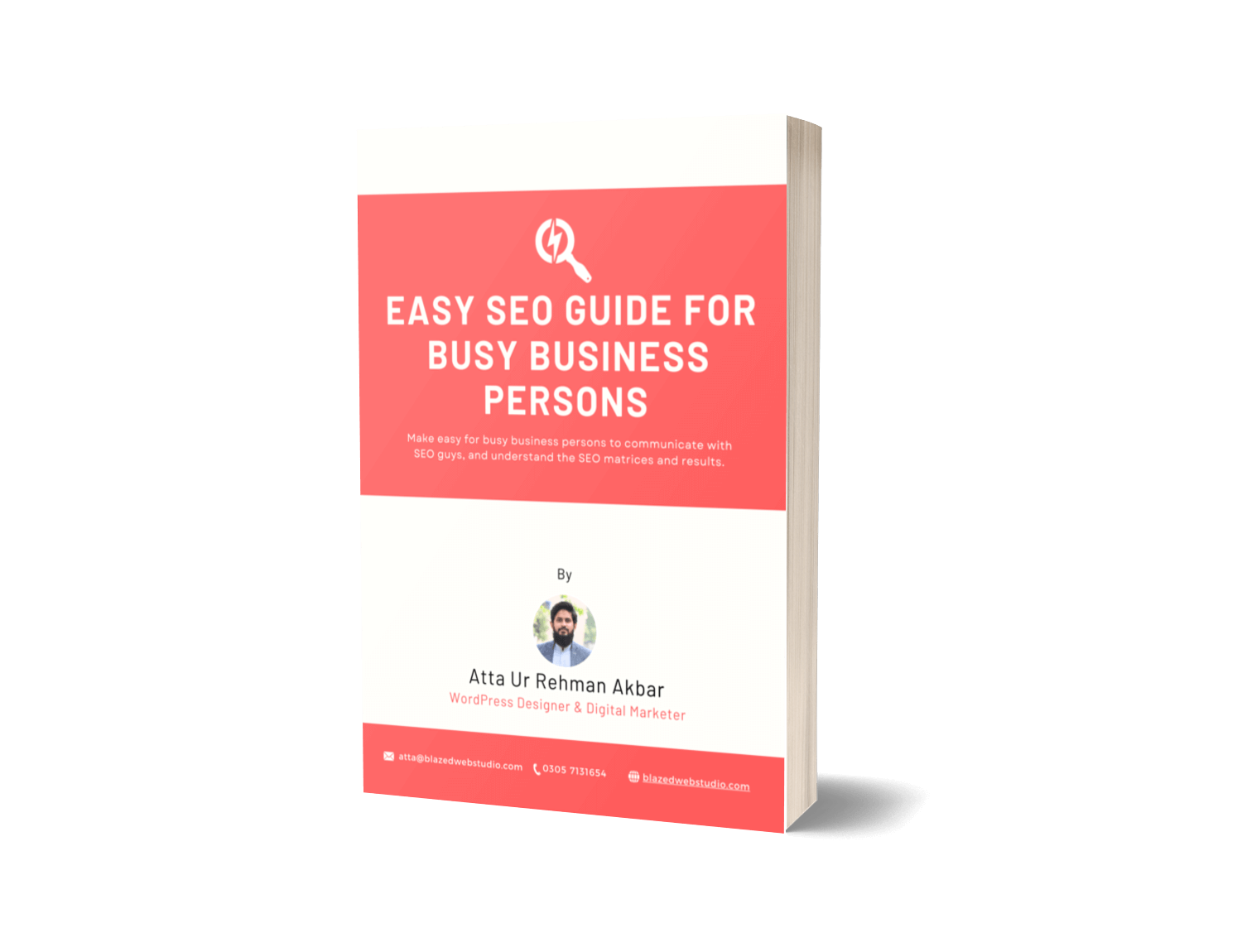
Whether you want to start a career in SEO, manage your own business website without depending entirely on an agency, or launch your own small SEO services business — this guide is your starting point. It covers what SEO is, how it works, which tools and team members you need, and what results to expect. No jargon. No fluff. Just a practical SEO guide for beginners.
- Easy SEO guide for beginners & busy business persons
- 1. Some Motivating Stats:
- 2. What is SEO?
- 3. How Search Engines Work
- 4. How SEO works?
- The Three Pillars of SEO
- 4A. On-Page SEO
- 4B. Off-Page SEO
- 4C. Technical SEO
- 5. Tools Every SEO Beginner Needs
- 6. Building Your SEO Team
- 7. How you can measure the results?
- Schedule a Meeting
- 8. Your 90-Day SEO Action Plan
- Glossary:
- Frequently Asked Questions
- Q1: What is the cost of SEO in Pakistan?
- Q2: Is SEO dead or evolving in 2026?
- Q3: Is SEO replaced by AI?
- Q4: What are the main parts of SEO I should know as a business owner?
- Q5: Is SEO a monthly fee?
- Q6: Is SEO in high demand?
- Q7: How long does SEO take to show results?
- Q8: Can I do SEO myself, or do I need to hire an expert?
- Q9: How do I know if my SEO is actually working?
- Q10: What is the fastest way to improve my website's SEO?
- Don't forget to share!
1. Some Motivating Stats:
- Top Traffic Source (HubSpot Report)
- The below stats show the traffic that comes from Organic, Direct, and Referral in combine more then any other channel. That is the reason SEO is important.
- Nearly one-fourth (22%) of web professionals surveyed in 2022 said direct traffic was their top source.
- Traffic portion by Display Ads (12%), Paid Search (9%), Referral (9%), Other (%1).
- Following direct was organic search (17%), social (16%) and email (14%)”. Source.

- Top Ranking Positions Earned Clicks (Backlinko Report)
- Top ranking positions see the most clicks: Studies consistently show that the top positions on search engine results pages (SERPs) garner the majority of clicks. Backlinko reports that the first result on Google receives 31.9% of clicks, emphasizing the importance of ranking highly for relevant keywords. Source.

- Top ranking positions see the most clicks: Studies consistently show that the top positions on search engine results pages (SERPs) garner the majority of clicks. Backlinko reports that the first result on Google receives 31.9% of clicks, emphasizing the importance of ranking highly for relevant keywords. Source.
- Leads source with most close-rate (HubSpot Report)
- SEO leads are more likely to convert: Compared to other marketing channels, leads generated through organic search tend to have a higher conversion rate.
- HubSpot: States that leads from SEO have a 14.6% close rate, compared to 1.7% for outbound leads. Source
- SEO leads are more likely to convert: Compared to other marketing channels, leads generated through organic search tend to have a higher conversion rate.


The takeaway: ranking on page one of Google is not a vanity goal — it is a business growth strategy. And it is a learnable skill.
2. What is SEO?
Simple definition: SEO (Search Engine Optimization) is the process of improving your website so it appears higher in search results when people look for products or services you offer — without paying for ads.
Example: You run a printing company in Faisalabad. When someone types “printing company in Faisalabad” into Google, SEO determines whether your website appears on page 1 or page 5. Page 1 gets clicks. Page 5 is invisible.
For business owners: More traffic, more leads, and more customers — without ongoing ad spend.
For career seekers: SEO professionals are in high demand locally and globally. Pakistani freelancers earn well by serving international clients on Upwork and through direct outreach.For aspiring agency owners: SEO services are recurring revenue. A small portfolio of 5-10 clients managed well can build a sustainable freelance or agency business.
3. How Search Engines Work
Understanding this is foundational. Search engines work in three stages:
Stage 1 — Crawling
Search engines send out automated bots (crawlers) to discover web pages by following links across the internet.
Stage 2 — Indexing
Once a page is crawled, it is stored in Google’s index — the massive database that search results are pulled from. Only indexed pages can appear in results.
Stage 3 — Ranking
When someone searches, Google scans its index and ranks pages based on hundreds of factors: relevance, authority, speed, mobile-friendliness, user experience, and more. Your job as an SEO practitioner is to optimize for these factors.
4. How SEO works?
- A. Think like your customers: What would they type into Search Engines to find a business like yours? The are called “Keywords”, what they type to search in for something relevant to your business.
- Example: “Printing Company in Faisalabad”.

- Example: “Printing Company in Faisalabad”.
- B. Target relevant keywords: Include these keywords strategically in your website content and titles. Choose only keywords with a monthly Search Volume of more than 70.
- Example: “Town Crier printing company in Faisalabad”.
- C. Create valuable content: Informative blog posts, product descriptions, and “about us” sections attract visitors and establish your expertise.
- D. Optimize website for mobile browsing: Many searches happen on phones, so make sure your website is mobile-friendly.
- E. Get mentioned online by others: Talk to other blog writers and get a link from their website to your website. Also, posting on social media with a link to your website will help you get traffic.


The Three Pillars of SEO
Every SEO strategy — whether for your own site or a client’s — is built on three core areas:
4A. On-Page SEO
On-page SEO is everything you do on the website itself to help search engines understand and rank your content.
- Keyword Research: Identify what your target customers type into Google. Use tools like Google Keyword Planner or Ubersuggest. Target keywords with 70+ monthly searches and manageable competition.
- Title Tags & Meta Descriptions: Each page needs a unique title (under 60 characters) containing your main keyword. The meta description (under 160 characters) influences click-through rate in search results.
- Headings (H1, H2, H3): The H1 is your page’s main title and should include the primary keyword. Use H2s and H3s to organize subtopics logically.
- Content Quality: Write content that genuinely answers user questions better than competitors. Google rewards depth, clarity, and demonstrated expertise.
- Internal Linking: Link between your own pages. This helps search engines discover all your content and helps users navigate.
- Image Optimization: Add descriptive alt text to every image. Compress files for faster loading. Use keyword-relevant filenames.
4B. Off-Page SEO
Off-page SEO refers to actions outside your website that build its authority and trust in Google’s eyes. It’s about getting good recommendations from other websites. These websites can be business directories, blogs news websites, or even social media.
- Backlinks: A link from another website to yours acts as a vote of confidence. More high-quality backlinks = higher domain authority = better rankings.
- Guest Blogging: Write articles for industry websites and include a link back to your site.
- Business Directories: Submit your business to Google Business Profile, local Pakistan directories, and industry-specific directories.
- Social Signals: Social media links drive traffic and increase the chance of earning real backlinks from other sites.
- Brand Mentions: Even unlinked mentions of your brand name help build authority over time.
4C. Technical SEO
Technical SEO ensures search engines can access, crawl, and index your website without problems. Poor technical health can sabotage even great content.
- Site Speed: Pages should load in under 3 seconds. Use Google PageSpeed Insights to test and fix issues.
- Mobile-Friendliness: Over 60% of searches happen on mobile. Your site must look and function perfectly on phones.
- HTTPS / SSL Certificate: Google flags non-secure (HTTP) sites. Ensure your website has SSL installed.
- XML Sitemap: A sitemap.xml file lists all your pages and helps Google find and index them faster. Submit it in Google Search Console.
- Robots.txt: This file tells crawlers which pages to visit and which to skip. Misconfiguring it can accidentally block your entire site from Google.
- Core Web Vitals: Google’s official page experience metrics — Largest Contentful Paint (LCP), Interaction to Next Paint (INP), and Cumulative Layout Shift (CLS). Monitor these in Google Search Console.
5. Tools Every SEO Beginner Needs
You do not need to spend a lot to start. Here is a practical toolkit:
| Tool | Purpose & Cost |
| Google Search Console | Free — Monitor rankings, indexing errors, Core Web Vitals, clicks. Install on every site. |
| Google Analytics 4 | Free — Track traffic sources, user behavior, and conversions. |
| Google Keyword Planner | Free — Research keyword ideas and monthly search volumes. |
| Ubersuggest | Free (limited) / Paid — Keyword research and basic competitor analysis. |
| Ahrefs or SEMrush | Paid ($100-130/mo) — Professional keyword research, backlink audits, rank tracking. Essential for agencies. |
| Rank Math or Yoast SEO | Free WordPress plugin — Optimize title tags, meta descriptions, sitemaps on WordPress sites. |
| Google PageSpeed Insights | Free — Diagnose and fix page speed issues. |
| Screaming Frog | Free up to 500 pages — Crawl sites to find broken links, missing tags, duplicate content. |
For beginners starting out: Google Search Console + Google Analytics 4 + Rank Math plugin gives you everything needed to manage basic SEO at zero cost.
6. Building Your SEO Team
Whether you are a business owner or starting an SEO agency, here is how to think about roles and resources.
Solo Business Owner (DIY)
With the right tools and a few focused hours per month, you can handle:
- Publishing 2-4 keyword-targeted blog posts per month
- Updating title tags and meta descriptions on key pages
- Monitoring Google Search Console for errors and ranking progress
- Building local citations and directory listings
Time required: 5-10 hours per month for basic SEO maintenance.
Small Business — In-House SEO Team
| Role | Key Responsibilities |
| SEO Specialist | Keyword research, on-page optimization, monthly reporting, Google Search Console monitoring |
| Content Writer | Blog posts, landing page copy, product descriptions optimized for target keywords |
| Web Developer (part-time) | Technical SEO fixes, site speed improvements, schema markup, sitemap management |
Starting Your Own SEO Services Business
A realistic path from beginner to small agency owner:
- Start solo. Offer on-page SEO and monthly reporting to 2-3 small local businesses at affordable rates.
- Once you have 3-5 paying clients, hire a freelance content writer for blog posts.
- Add a link building specialist as you grow to 8-10 clients.
- Use a project management tool (Trello or Notion) to track deliverables for each client.
- Invest in Ahrefs or SEMrush once monthly revenue justifies it — it becomes a client-winning tool.
Minimum viable toolkit for an SEO agency: Google Search Console (free), Rank Math (free), Ahrefs or SEMrush (paid), Google Docs/Sheets for reporting, and a simple monthly email update template for clients.
7. How you can measure the results?
Well, simply ask the following questions to your social media manager.
- How many followers do you have this week?
- What kind of content is getting the most views?
- What are the audience demographics who are visiting your social channel?
- Are the audience engaged with content, how many Impressions, comments, reactions, and reposts do you have this week?
Schedule a Meeting
If you have a business website but not get sales or leads through it, then consult the best SEO Agency in Pakistan.
8. Your 90-Day SEO Action Plan
A practical roadmap whether you are managing your own site or beginning an SEO career:
| Timeframe | Focus & Actions |
| Month 1 — Foundation | Install Google Search Console + Analytics. Set up Rank Math. Audit existing pages for missing title tags and meta descriptions. Research 20-30 target keywords. Fix broken links and speed issues. Submit sitemap. |
| Month 2 — Content & On-Page | Optimize your 5 most important pages. Publish 2-4 blog posts targeting your keywords. Set up or optimize your Google Business Profile. Begin internal linking between related pages. |
| Month 3 — Authority & Measurement | Get listed in 5-10 business directories. Reach out to 2-3 blogs or industry sites for guest posts or link placements. Review rankings. Set up monthly reporting routine. Identify what is working and double down. |
SEO results typically appear between 3 and 6 months. New websites can take longer. Consistency and patience matter more than perfection.
Glossary:
Social Media General Terms:
- Analytics: Data that helps you understand how your social media content is performing. This can include metrics like engagement, reach, and clicks.
- Audience: The people you’re trying to reach with your social media content.
- Bio: A short description of yourself or your brand on a social media profile. Also available on your business pages for every social media.
- Call to Action (CTA): A statement/button that tells users what you want them to do after seeing your content, such as “Click here to learn more” or “Shop now.”
- Content Curation: Finding and sharing relevant content from other sources.
- Engagement: The interaction your content receives, such as likes, comments, and shares.
- Hashtag (#): A word or phrase preceded by a # symbol used to categorize content and make it discoverable. These tags help your post to get more views.
- Impression: The number of times your content is displayed on a user’s screen. One person can view your post multiple times. Mostly the Impression Frequency is 1.5 to 2.
- Key Performance Indicator (KPI): A measurable value that demonstrates how effectively you’re achieving your social media goals. For instance, Followers, engagement, and Impressions.
Community Management Terms:
- Community Manager: The person responsible for building and managing relationships with your audience on social media.
- Direct Message (DM): A private message sent between two users on a social media platform.
- Engagement Rate: A metric that shows how well your content is resonating with your audience. It’s typically calculated by dividing the total number of engagements (likes, comments, shares) by the number of impressions and multiplying by 100.
Content Creation Terms:
- Content Marketing: Creating and sharing valuable content to attract and retain an audience.
- Evergreen Content: Content that remains relevant and valuable over time.
- Story: Short, disappearing video or photo content on platforms like Instagram and Facebook.
Frequently Asked Questions
Easy SEO Guide for Busy Business Persons | blazedwebstudio.com
Q1: What is the cost of SEO in Pakistan?
SEO pricing in Pakistan varies based on competition, scope, and agency expertise. Basic packages can start from a few thousand rupees per month, while comprehensive campaigns for competitive industries cost significantly more. Focus on value over price cheap SEO often leads to penalties and wasted time. A trusted SEO agency in Pakistan will always offer transparent reporting and a proven track record.
Q2: Is SEO dead or evolving in 2026?
SEO is far from dead rather it’s evolving rapidly. With AI now influencing search results, SEO has shifted from simple keyword stuffing to semantic relevance, content authority, and AI-friendly structure. Businesses that adapt their SEO strategy to this new landscape will continue to grow organically.
Q3: Is SEO replaced by AI?
No. AI tools like ChatGPT and Google’s AI Overviews are changing how people search, but they still pull information from well-optimized websites. In fact, strong SEO is now more important than ever it helps your content get cited inside AI-generated answers, not just traditional search results.
Q4: What are the main parts of SEO I should know as a business owner?
There are three core areas every business owner should understand:
- On-Page SEO – Optimizing your content, headings, and keywords.
- Off-Page SEO – Building backlinks from other reputable websites.
- Technical SEO – Ensuring your site is fast, secure, and mobile-friendly.
Q5: Is SEO a monthly fee?
Yes, in most cases SEO is an ongoing monthly service. Unlike a one-time website build, SEO requires continuous work — content creation, link building, performance monitoring, and algorithm updates. Think of it like a gym membership: results come with consistent effort over time.
Q6: Is SEO in high demand?
Absolutely. As more businesses move online in Pakistan and globally, the demand for SEO services is growing fast. Customers now search online before making almost every purchase decision, making SEO one of the highest-ROI digital marketing investments for any business.
Q7: How long does SEO take to show results?
SEO typically takes 3 to 6 months to show meaningful results, depending on your industry’s competition, content quality, and strategy consistency. It’s a long-term investment — but once you rank, the traffic keeps coming without ongoing ad spend.
Q8: Can I do SEO myself, or do I need to hire an expert?
Basic tasks like writing keyword-rich content can be done in-house. However, for faster, sustainable results, working with a professional SEO agency in Pakistan ensures your strategy is built correctly from the start and avoids costly mistakes.
Q9: How do I know if my SEO is actually working?
Track these three key metrics:
- Organic traffic via Google Analytics
- Keyword rankings via Google Search Console
- Leads or sales generated from organic search
Ask your SEO manager for a monthly report covering all three.
Q10: What is the fastest way to improve my website’s SEO?
The quickest wins for busy business owners:
- Make your website mobile-friendly
- Add target keywords to page titles and headings
- Claim and optimize your Google Business Profile
- Get listed in local business directories
- Start publishing helpful blog content consistently